
I was doing a blog series on Parisian landmarks to celebrate the publication of my novella, Paris in Clichés. Well, it’s six years after its publication, and I figured it was time to revisit another landmark.
Previous landmarks I’ve explored are:
- Shakespeare and Company: A Bookstore as Cozy as You Imagine a Bookstore Would Be
- Berthillon: An Astonishing Ice Cream Shop on the Île Saint-Louis
- Bateaux Mouches on the River Seine
- Eiffel Tower
- Macarons at Ladurée on the Champs-Elysées
- Get Lost in the Louvre
- Take in the View from the Sacré-Cœur
Modernism at Musée D’Orsay
Everyone knows about the Louvre museum in Paris, maybe even more so now since its sensational robbery. But like any proper European city, Paris is packed with museums. And one of the most wellknown painting styles you might have heard of, Impressionism, is not found in the Louvre, but rather in the Musée D’Orsay.
Yes, you won’t see most of the works of Monet, Van Gogh, Renoir, or Degas at the Louvre (though they have a few). It’s the Musée D’Orsay that specializes in 19th and early 20th-century art. Here you can see where art styles went after Italian Renaissance masterpieces like Leonardo da Vinci’s Mona Lisa and Veronese’s The Wedding Feast at Cana.
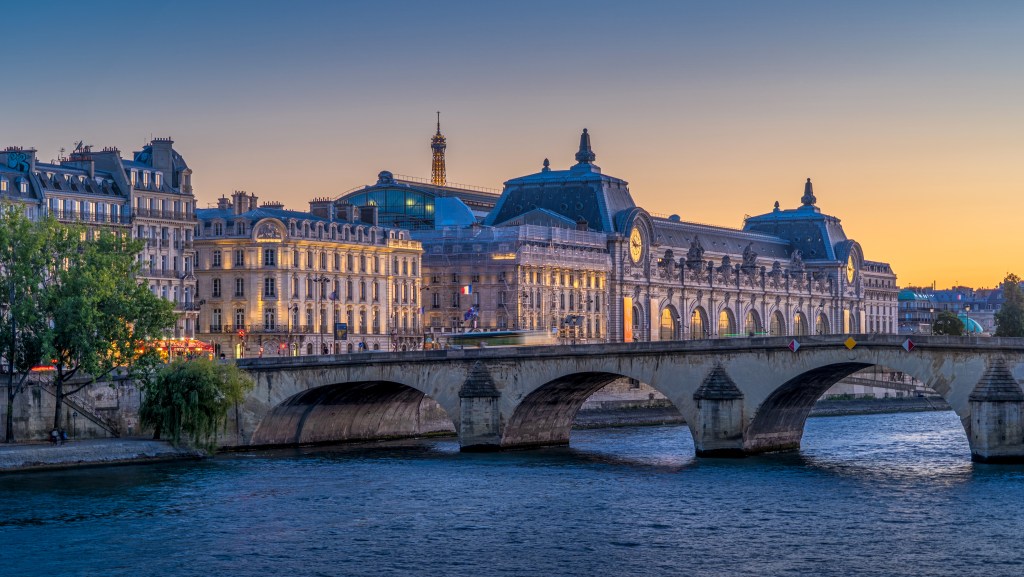
Just like the Louvre, the Musée D’Orsay is in a building that used to be something else. Instead of a palace, it’s in an old train station – but a stunning train station! If you were walking through the Tuileries Garden, you’d cross the Seine at the Pont Royal, and there you’d find stretched out along its banks is the former train terminal that was built for the 1900 Exposition Universelle. At the time, it was a grand and modern building. When no longer needed for trains, it was eventually converted into a museum.
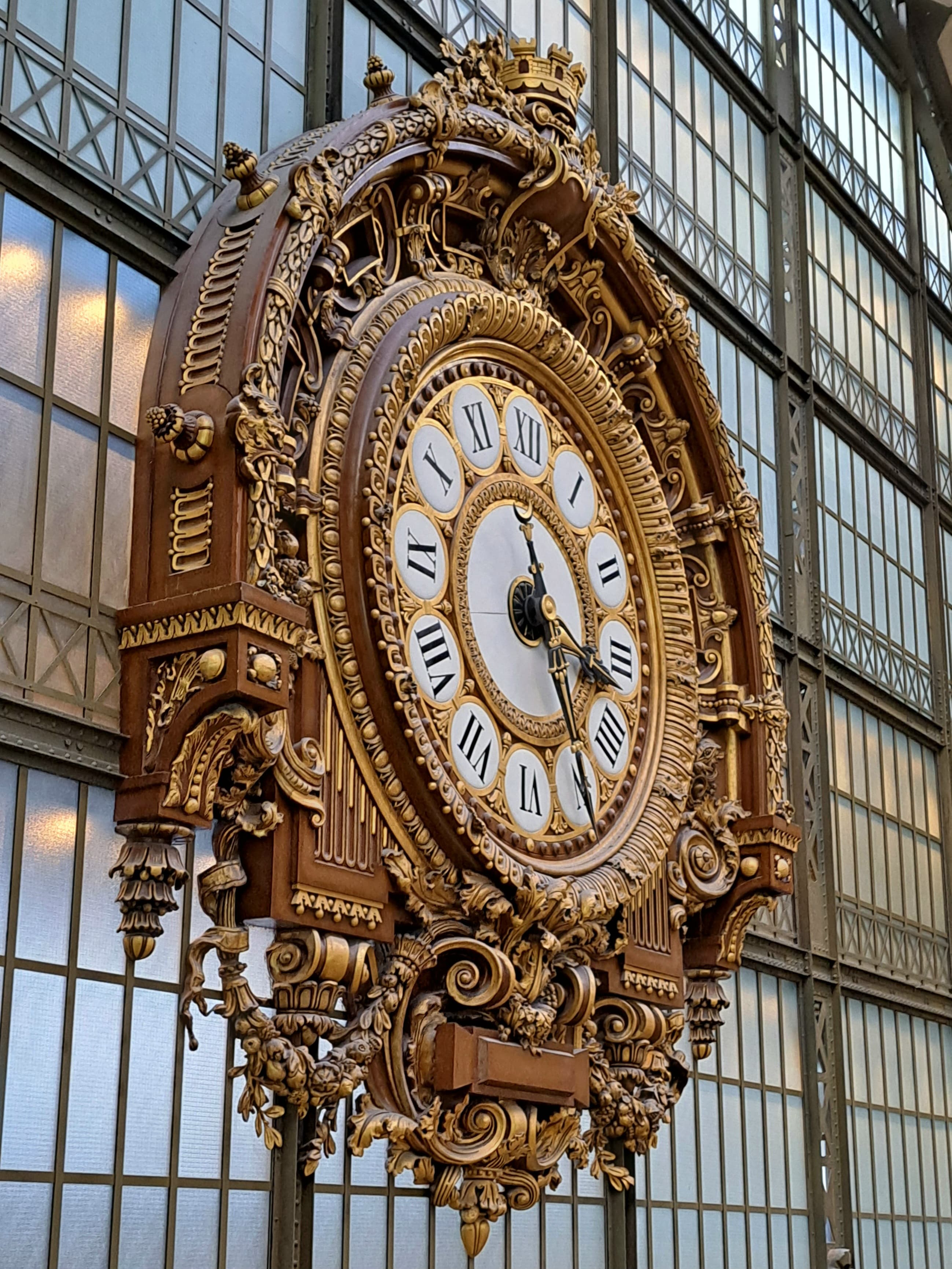
And it works well as a museum, with a vaulted glass roof that lights the artwork beautifully, and large spaces for galleries. Clocks are an outstanding feature It the building – there’s an ornate clock in the main hall that used to alert travellers when they were late for their trains. And on the fifth floor, the Café Campana also features a glass-and-steel clock in the windows. The building was designed to fit into the neighbourhood around it and it suits the area beautifully – unlike the proposal architect Le Corbusier put forward to replace it (which was thankfully not permitted, and the former train station became an art gallery instead).

It’s apparently the sixth most visited gallery in the world, and it’s full of impressionist and post-impressionist art. What’s that, you ask? Think of a brief, fleeting impression of a scene, like a sunset over the water or the whirl of a ballerina’s skirt. Rather than capturing every detail of a scene, Impressionists try to capture the flecks of colour and movement that your eye might pick up when taking something in. Anyway, it was a new style of painting, and while it was seen as controversial and rebellious at first, it gradually became popular. If you flick through a gallery of these works, you’ll probably come across several you’ve seen before. And many of these paintings can be seen at the Musée D’Orsay.

(As a side note, I find it interesting that the fresh colour many of these paintings have was enabled by new technology in paint – older paintings simply has less colours because other colours of paint didn’t exist yet. So if you visit the Louvre and the Musée D’Orsay, see if you notice a difference in the variety of colours used in, say, the Mona Lisa vs. Tahitian Women on the Beach)
I took a course on 19th century art in university, and it was fascinating to see many of the works I’d learned about up close in this museum. It’s always much better to see art in person. It’s hard to put into words what the difference is, but somehow you think about a painting more when you’re right there in front of it.
The museum doesn’t just have paintings, it also has sculptures, art nouveau furniture, and architectural drawings. It’s actually currently being expanded, and of course I haven’t seen the new parts. Maybe you can make the time to check it out if you happen to be in Paris!
Make sure you follow this blog so you don’t miss the next landmark.
***
My novella set in Paris, Paris in Clichés, can be found here.
***
Want more from me? Enter your email to get my author newsletter–it takes a monthly deep dive into different topics of Christian faith. Or check out a sample issue here.
Posts in this series:
- Paris is Still Always a Good Idea
- Shakespeare and Company
- Berthillon: An Astonishing Ice Cream Shop on the Île Saint-Louis
- Bateaux Mouches on the River Seine
- Don’t Miss the Eiffel Tower
- Macarons at Ladurée on the Champs-Elysées
- Get Lost in the Louvre
- Take in the View from the Sacré-Cœur
- Meander in Montmartre

 Hmm...
What do you think? Comment here!